Intellectual Property (IP) is a vast and a bit complex term, which refers to the intangible creations of the human intellect. Artistic works, including writings and music, symbols, developed words, and phrases, scientific or non-scientific inventions and discoveries, all fall under the category of IP. In the present highly competitive business environment, Intellectual Property Laws exist to encourage the continued creation of a diverse range of innovations and inventions by offering Intellectual Property Protection against unauthorized use and theft. However, many people across the globe often get confused and incorrectly use the terms defined in IP law. Read More
Showing posts with label Copyright. Show all posts
Showing posts with label Copyright. Show all posts
Thursday, January 9, 2020

Thursday, December 5, 2019
How Copyright Infringement Takes Place on the Internet
Copyright Infringement Takes Place on the Internet

One can never deny the fact that the Internet is indeed one of man's profound inventions and innovations of the millennium. The Internet refers to the global network of interconnected computers and networks, which is accessible at a negligible cost, and to almost every other person on the planet. While being the quickest source of information, the Internet, however, is both a boon and bane. Copyright owners across the globe often refer to the Internet as a curse more than a blessing. The reason behind the same lies in the fact that the Internet is the most predominant threat to their corresponding Intellectual Property Rights (IPRs) associated with a Copyright. Let's first make ourselves familiar with why the Internet poses a threat to the unique creations of the Copyright holders by considering the points specified below:
- The Internet is accessible to any person and at any time without considerable impediments.
- It offers a platform for wide dispersion and distribution of information quickly within a few clicks.
- The cost associated with distribution is almost next to nil.
- The original creation and its replica or copies aren’t easy to distinguish.
INFRINGEMENT OF COPYRIGHT ON THE INTERNET
Copyright Infringement on the Internet has nowadays become more prevalent than ever before. Due to its characteristics, the Internet is undoubtedly a threat to copyright owners. The peculiar feature of copyright infringement on the Internet is the point that it is arduous to determine whether a work is a copy of the original creation or not. On the other hand, making a distinction in the tangible medium is a completely hassle-free process. It is imperative to make a point of the fact that infringement may not always be intentional; it can be due to ignorance as well.On the Internet, possible copyright infringement can take in several forms. Let us discuss each of these different avatars one by one.
- FRAMING - It refers to the process in which a website is allowed to include the contents from another independent website in its frame such that the framing website appears as the original one. In framing, every frame functions independently, due to which, the information downloaded in one frame stays inside it without overlapping with any other frame. Consequently, the users remain at the framing website and view its content by staying unaware of the fact that the content comes from another framed website.
- LINKING - Linking refers to the process of connecting the users from the original website to a linked website. The user is given access to the linked website on the original website itself with no need of typing the URL separately. For research purposes, linking proves to be beneficial to the users; however, it gives rise to several different legal issues.
- CACHING - Caching refers to the process in which a material is copied from its source to cache (space of temporary storage). The material shall be available to the users for a temporary period. Caching can be executed in several ways, for instance - copying a document displayed on the computer screen while accessing the web.
- PUBLIC DISPLAY OF RIGHT IN POSTING OR UPLOADING
- ARCHIVING
Ref- https://www.kashishworld.com/blog/how-copyright-infringement-takes-place-on-the-internet/
Monday, December 2, 2019
Protecting Ideas and Innovations Using Three Types of Intellectual Property (IP)
For protecting an idea so that someone else can't steal it, it is essential to secure one or more of the different forms of Intellectual Property (IP). Quite often, every invention begins as its owner's trade secret. Hence, there is a need to go ahead with Trademark Registration, Patent Protection, or Copyright Registration and have Intellectual Property Protection in hand before marketing the innovations or inventions. Most of the people around the world are not aware of the fact or haven't yet fully realized that they can protect their innovations using various forms of IP. Let us consider an example to have a better understanding of this concept. The brand 'Coca-Cola' is a trademark; its recipe is a trade secret; Copyright Protection is there on its packaging art, and its bottle or Can are protected by both a design patent and trademark in the form of trade dress. In the same manner, your unique product or invention can also seek protection by more than one type of IP. It is imperative to parse out which aspects of your innovation are suitable for Trademark Protection, patent protection, and copyright protection, respectively.

A few examples of copyrightable works include videos, articles, movies, books, software, and photos. Copyright protection doesn't extend to ideas or useful items, which fall under patent protection. It is a matter of fact that yes - software is a functional item, yet it can get copyright protection due to the creativity involved in the entire process of selecting, ordering, and arranging multiple pieces of code in the software.
Ref- https://www.kashishworld.com/blog/protecting-ideas-and-innovations-using-three-types-of-intellectual-property-ip/

TRADEMARK
Safeguarding a brand's name deserves the utmost importance as one would never want to invest time and money at a later stage after finding out that someone else is already using his or her registered mark. A trademark is a name, symbol, or sign associated with a product or service and is known to protect a brand. To be specific, a trademark is anything that helps the customers in identifying a product or its source. Moreover, other things like color, sound, or smell can serve as a trademark too. The most common types of trademark include logos, watermarks, and slogans. If you are planning to go ahead with trademark registration, start by protecting the wordmark first and then seek trademark protection for the other aspects of your product as a part of your overall marketing and business strategy. Besides, it is highly advisable to conduct a thorough search before filing a Trademark Application and ensure that nobody else is using a similar mark.COPYRIGHT
Almost every product can seek copyright protection for at least one of its aspects. For instance - the images or words on the product's packaging, its label, and the product itself; can all be protected with a copyright. A few advantages of copyright registration include that the process is inexpensive, and the copyright is comparatively easier to secure. Copyright protection extends to the original and creative works of authorship that are fixed in a tangible medium of expression. It implies that creative or innovative works have been either written or drawn on paper, saved on an electronic storage device, or preserved in some other tangible format.A few examples of copyrightable works include videos, articles, movies, books, software, and photos. Copyright protection doesn't extend to ideas or useful items, which fall under patent protection. It is a matter of fact that yes - software is a functional item, yet it can get copyright protection due to the creativity involved in the entire process of selecting, ordering, and arranging multiple pieces of code in the software.
PATENT
A patent offers an owner or inventor the exclusive rights to his or her invention and excludes others from using, selling, manufacturing, distributing, or licensing the product until the term of patent protection. Generally, a patent is defined using three attributes, namely, newness, non-obviousness, and usefulness. Patent protection helps in establishing a healthy market position as your new idea or invention can prove to a great differentiator among your business competitors. Also, you can commercialize the concept to earn higher returns on your investment. An interesting thing about receiving a patent is that even if you don't have enough time to exploit your invention, you can still license or sell it for generating a new income stream. Without patent protection, the world economy shall become a place of less creativity, innovation, and discovery.Ref- https://www.kashishworld.com/blog/protecting-ideas-and-innovations-using-three-types-of-intellectual-property-ip/
Monday, October 7, 2019
Beware of Instagram's New Copyright Phishing Scam!

A new phishing scam is targeting most of the Instagram users by accusing them of Copyright Infringement and obtaining their credentials. It baits the users into giving away their login details using bogus copyright infringement alerts. The attack begins with a phishing email distributed as a part of this fake campaign that claims a user's account will be suspended in 24 hours for violating Instagram's Copyright Law. It triggers the users with a copyright notice and the users who wish to refute the claim can do so by clicking on the 'Copyright Objection Form' button embedded in the same email.
FAKE ALERTS OF COPYRIGHT INFRINGEMENT
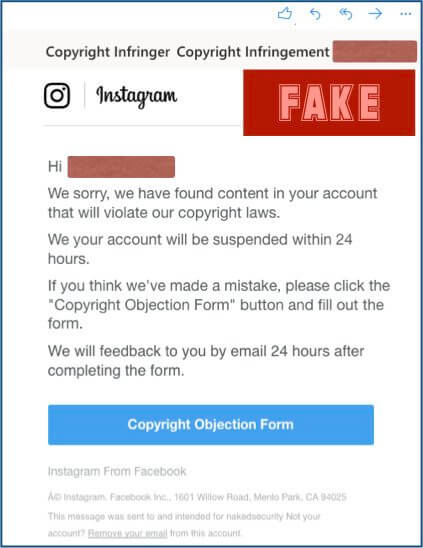
The page seeks to appear legitimate and official by using an SSL certificate, represented by 'HTTPS' in the address bar and green padlocks. If the users click through, they would then be asked to give their email id, date of birth, and Instagram password. After obtaining all the private information of the users, the phishing page redirects them to the official Instagram login page for maintaining the illusion that the copyright objection form was authentic. If the Instagram users fall for this trick, the hackers can take control of their accounts undisturbed.
WHAT CAN THE USERS DO?
It is a matter of fact that yes; some of the Instagram users are bound to fall for such kind of scams. If you have got either your account hacked or credentials stolen but can still access the account, you first need to check whether your correct email id and mobile number are still associated with your account or not. For doing so, click on 'Edit Profile' option and scroll down to view the current mobile number and email id. If the attackers have changed the info, try to enter your details. After this, you should change your password as well, which would automatically log off all devices currently logged into your account, and give you the full control of your account. In case you lose complete access to your account, you can report the incident to Instagram's security and wait for Instagram to confirm your identity with either your mobile number or email id using which you had signed up.Such scams are yet another reminder for all the users to read the emails carefully and further inspect the URLs of all the links. They should also enable two-factor
Ref- https://www.kashishworld.com/blog/beware-of-instagrams-new-copyright-phishing-scam/
Tuesday, September 17, 2019
Business Entity Names, Domain Names, and Trademarks - What Are They?
People who are either dealing with a company, starting a new venture, or running a business need to know what are business entity names, domain names, and trademarks and how to use them for increasing revenue. Each of these three terms has a unique purpose and core concepts and must be used adequately for establishing a successful business presence. Let's understand this with an example. Apple Inc. is a business entity name denoting a legal entity, which in this particular case is a publicly-traded United States Corporation. 'Apple.com' is one of the many domain names owned by Apple. 'Apple' is the Registered Trademark of the technology giant with the US Patent and Trademark Office (USPTO). At the very first glance, all these three terms seem to be incredibly similar as they all incorporate the name 'Apple.' However, from a legal viewpoint, it is critical to bring up that each term is different as the legal rights associated with them differ extraordinarily.

BUSINESS ENTITY NAMES
When we apply for an entity name with the department of a particular state, we are registering that entity, organization, or publicly traded corporation to do business in that respective state. Some common types of business entities (but not exclusively limited to) include:
DOMAIN NAMES
A domain name is in the form of .com, .org, .net, or other web addresses existing for people and companies to find your business online. While selecting a name for your business, you must also see whether its corresponding domain name is available or not. In many cases, someone else can also buy the same domain name with a different top-level domain name. For instance, if you own the domain name, 'company-name.com,' others may own 'company-name.org' or 'company-name.net.' The domain names have a centralized registration process. A domain name is only the name of your website and owning the same won't give you any Trademark Rights.
TRADEMARKS
Registered trademarks protect the symbols, phrases, logos, or names that distinguish the source of products and services of one party from another. Some of the most famous and widely recognized trademarks include Google, Rolex, and Vodafone, to name a few. If used lawfully and enforced positively, trademarks safeguard the brand's entity by not letting any other person or company use the same without permission. In case, the trademark holder comes across a similar trademark, that may create a likelihood of confusion in the mind of a consumer, he can initiate legal proceedings against the allegedly infringing user in the court.
DIFFERENCES AND SIMILARITIES
People often consider business entity names and domain names as the same since they aren't aware of the unobtrusive contrasts. While a domain name only points to the online presence of a business, a business entity name, on the other hand, refers to the legal representation of a valid business. A domain name can be changed if required, but a business entity name usually stays the same. Trademarks are the exclusive form of Intellectual Property Rights (IPRs) that can prevent the unauthorized use of a brand by any other individual or entity. Though different, they are all confused with each other at some point or the other.
Ref: https://www.kashishworld.com/blog/what-are-domain-names-business-entity-names-and-trademarks/

BUSINESS ENTITY NAMES
When we apply for an entity name with the department of a particular state, we are registering that entity, organization, or publicly traded corporation to do business in that respective state. Some common types of business entities (but not exclusively limited to) include:
- Limited Liability Companies (LLC)
- Corporations
- Limited Partnerships
DOMAIN NAMES
A domain name is in the form of .com, .org, .net, or other web addresses existing for people and companies to find your business online. While selecting a name for your business, you must also see whether its corresponding domain name is available or not. In many cases, someone else can also buy the same domain name with a different top-level domain name. For instance, if you own the domain name, 'company-name.com,' others may own 'company-name.org' or 'company-name.net.' The domain names have a centralized registration process. A domain name is only the name of your website and owning the same won't give you any Trademark Rights.
TRADEMARKS
Registered trademarks protect the symbols, phrases, logos, or names that distinguish the source of products and services of one party from another. Some of the most famous and widely recognized trademarks include Google, Rolex, and Vodafone, to name a few. If used lawfully and enforced positively, trademarks safeguard the brand's entity by not letting any other person or company use the same without permission. In case, the trademark holder comes across a similar trademark, that may create a likelihood of confusion in the mind of a consumer, he can initiate legal proceedings against the allegedly infringing user in the court.
DIFFERENCES AND SIMILARITIES
People often consider business entity names and domain names as the same since they aren't aware of the unobtrusive contrasts. While a domain name only points to the online presence of a business, a business entity name, on the other hand, refers to the legal representation of a valid business. A domain name can be changed if required, but a business entity name usually stays the same. Trademarks are the exclusive form of Intellectual Property Rights (IPRs) that can prevent the unauthorized use of a brand by any other individual or entity. Though different, they are all confused with each other at some point or the other.
Ref: https://www.kashishworld.com/blog/what-are-domain-names-business-entity-names-and-trademarks/
Friday, July 26, 2019
Protection of Domain Names

In today's highly competitive
business environment, a domain name is one of the most valuable Intellectual Property (IP) assets a
company could own. It is a matter of fact that yes; the choice of a domain name
in this age of well-developed information technology is an important business
decision as it leads to more publicity, popularity, and profitability of
businesses. So, it is essential to wisely select your domain name and protect
it irrespective of the fact whether you have been using it for years or have
just acquired it.
Here are a few simple tips that
owners should follow to protect their domain names:
1. Pay due
attention to the administrative details
While registering the domain name,
the owner should make sure that he or she is listed as the registrant, i.e.,
the legal owner of the domain name; the administrative contact, i.e., the
individual who has the rights to alter the domain record; and the technical
contact, i.e., the individual who will be responsible for addressing any
technical issues with the domain name.
2. Always go
for a reputable registrar
Large companies and organizations
usually work with corporate registrars like MarkMonitor to manage their domain
names efficiently. While using a retail registrar like GoDaddy or Network
Solutions, the owner should ensure that the registrar is widely-known,
responsive to the customers, and has been in the business for a long time.
3. Make sure
to lock your domain name
Many domain name registrars provide
the facility to lock, transfer lock, or register lock the domain name to
prevent it from being deleted, modified, or transferred without the owner's
prior and explicit permission.
4. Consider
obtaining similar domain names
Domain name holders or owners should
consider registering similar or alternative top-level domain names like .org,
.biz, and .net along with the domain names based on either the misspellings or
the plural version.
5. Create a
strong, unique password and protect it diligently
The owners should protect their
domain names from unauthorized access by using a strong and unique password.
Failing to do so could let someone else access your domain name, leading to its
misuse.
6. Keep
track of the renewal dates
The owners must establish a procedure
to ensure that they do not unintentionally forget to renew the registration of
their domain names. Owners with multiple domain names can even consider
consolidating the renewal dates of all their domain names to make the process
well organized. Additionally, renewing the domain name for multiple years could
also prove to be beneficial.
7. Be aware
of domain name scammers and others with evil intentions
Nowadays, unethical registrars often
try to manipulate the domain name registrants into paying unnecessary charges.
Therefore, the domain owners should be cautious while responding to any such
suspicious emails from parties pretending to be the registrar of their domain
names.
CONCLUSION
In today's internet age, your
company's domain name not only adds credibility to your business but also
builds your brand’s image by increasing its awareness. Domain names also help
in generating traffic to your website, which results in more customers and
better sales. Therefore, they must be efficiently protected to avoid any
unforeseen circumstances, which might arise, leading to disruptions in business
Monday, July 22, 2019
Marvel Wins Copyright Lawsuit Over 'Iron Man 3' Poster
Marvel Entertainment has finally won
a Copyright Infringement lawsuit
after four years that alleged the company had copied the design of their movie
poster for "Iron Man 3" from two comic book artists' work.

Horizon Comics Production, owned by
comic book artists and brothers Ben and Ray Lai, had sued Marvel in 2016 by
claiming that the official poster of Iron Man 3 was way too similar to the
appearance of a character named Caliban from their comic book series called
Radix. In their lawsuit, Horizon claimed that six employees of Marvel were well
aware of Radix and the design of Caliban. Additionally, the Copyright Infringement Lawsuit read
that two of those employees had even worked with the comic artists and
influenced the creators of the Iron Man 3 poster.
However, J. Paul Oetken, a US
District Judge in New York, in his ruling asserted that the poster was designed
based on inspiration boards made by Marvel's creative team, images from the
movies of Iron Man, and a photoshoot starring Robert Downey Jr. To this,
Horizon argued by saying that the two works were strikingly identical, and even
produced an expert report discussing the aspects of anatomical structures and
camera views. But the judge sided with Marvel by pointing out the differences
in the pose, placement of lights, and overall coloring. At last, the judge stated that in contrast to
Horizon's no virtual evidence of copying in the records, Marvel was successful
in introducing a piece of unrebutted evidence, which showed its independent
creation of the Iron Man 3 poster.
Subscribe to:
Posts (Atom)
-
 Fashion shows in today's time are more than just a couple of models walking the ramp adorning beautiful clothes and accessories. Contemp...
 -
.jpg) The hospitality industry of India has undoubtedly become an exceedingly crucial service provider across the nation. Due to the increase in t...
The hospitality industry of India has undoubtedly become an exceedingly crucial service provider across the nation. Due to the increase in t... -
 What is an Assignment of Copyright? An assignment is, in spirit, a transfer of ownership, even if it is partial. The copyright owner in an...