The provisions concerning Intellectual Property Rights (IPRs) were rationalized by the enforcement of the Agreement on the Trade-Related Aspects of Intellectual Property Rights (TRIPS). In addition to this Agreement, since all countries, developed and developing, alike have substantially grown and witnessed development in the manner of implementing provisions for providing in times of health crisis, TRIPS-plus measures have been adopted by some member states. To remove any barriers obstructing access to medicines, the Doha Declaration on TRIPS and Public Health and the WTO 2005 Ministerial Declaration introducing Art. 31bis in the TRIPS Agreement were implemented. For fostering better protection, preferential trade agreements (PTA) have also been concluded, of which the Trans-Pacific Partnership and later, the Comprehensive and Progressive Agreement for Trans-Pacific Partnership (CPTPP) have been adopted.

What is the Trans-Pacific Partnership (TPP)?
The Trans-Pacific Partnership is essentially a Trade Agreement that is wide in scope to include within its ambit twelve Pacific Rim countries, inclusive of the United States. The Agreement was the master plan of US President Barack Obama; however, it lingered on until Trump assumed presidentship. Due to Donald Trump's decision to withdraw the United States from the world's largest free trade deal, which comprised about forty percent of the entire global economy, the other eleven countries moved ahead while embracing a few changes in the original deal. The new deal came to be known as the Comprehensive and Progressive Agreement for Trans-Pacific Partnership (CPTPP).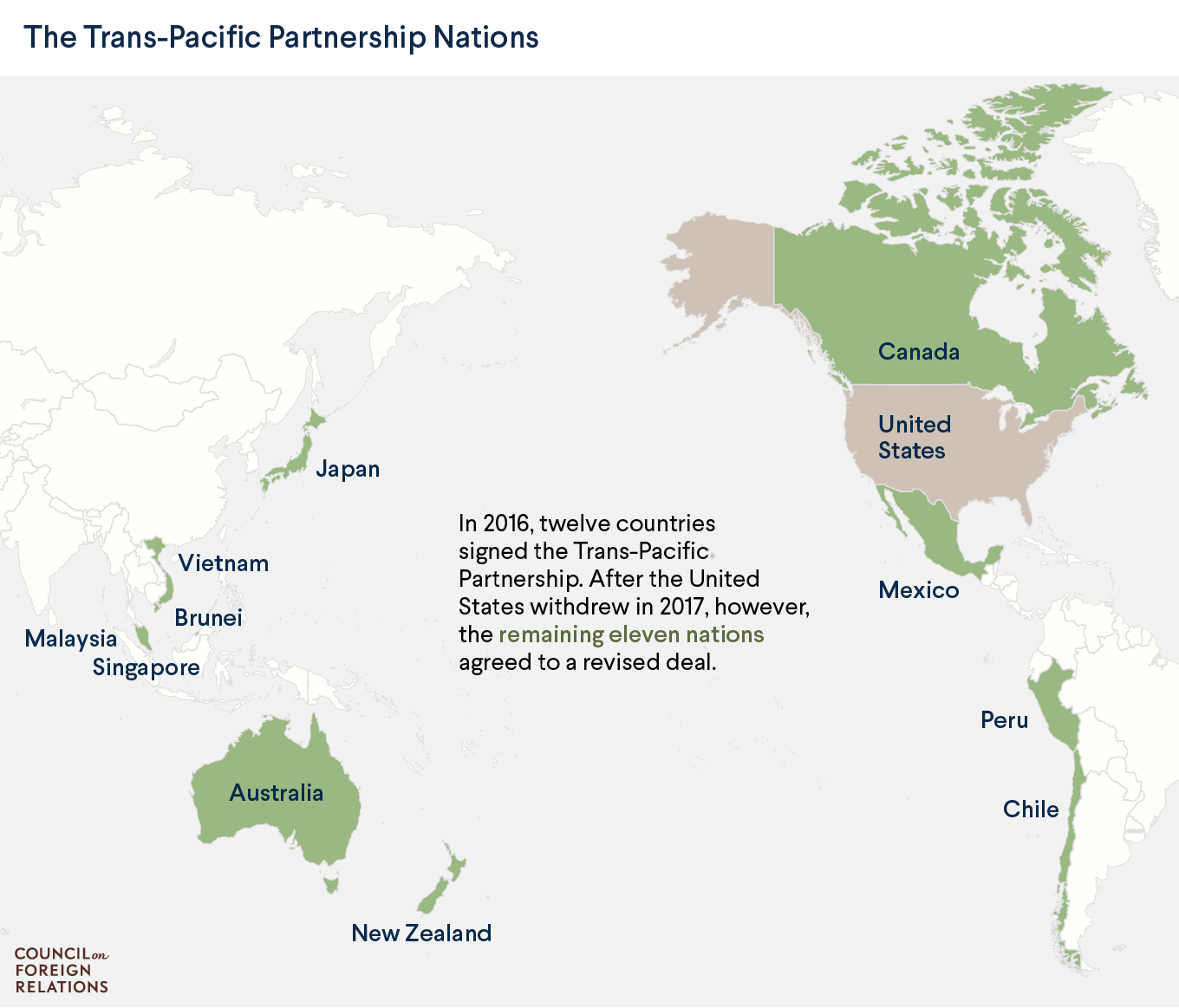
The TRIPS Agreement provided for minimum and common standards of protection of IPRs. It also provided that any additional protection may be afforded to complement the provisions within it. In such light came the TPP, which contained provisions on patentability, patent extension, test data exclusivity, and patent linkage that could adversely affect access to medicines. It had the following characteristic features:
- It broadened the protection for smell, sound, and color trademarks. It also limited marking to protect the use of common food names.
- It gave additional protection to the trade secrets by proposing criminal sanctions for cyber theft and theft of other trade secrets.
- It extended protection over undisclosed test data submitted for regulatory approval of pharmaceutical, agrochemical, or biological patents.
- It also emphasized that the term of protection for copyright shall be set to a minimum of seventy years after the life term of the author of the original work.
- It also expressed that the patents surrounding biotechnology shall be given extended protection since a majority of the patent term is lost in getting prior approval. Thus, for pharmaceuticals, at least five years of protection shall be mandated, and for agrochemical, the duration shall be at least ten years.
Delving into the Comprehensive and Progressive Agreement for Trans-Pacific Partnership (CPTPP)
The Comprehensive and Progressive Agreement for Trans-Pacific Partnership (CPTPP) or the TPP11 is a trade agreement between eleven countries, namely, Australia, Brunei Darussalam, Canada, Chile, Japan, Malaysia, Mexico, New Zealand, Peru, Singapore, and Vietnam, marking up to 13 percent of the world's Gross Domestic Production (GDP).
The CPTPP can be realized as an improvement of the TPP Agreement since it sought to regain a balance in the provisions dealing with IPRs to serve good not only to the interest the United States may have had but also to the other eleven members. It contains a comprehensive chapter on IPRs that establishes the standard of protection of IPRs across the Asia-Pacific region at a regional scale. It aims to provide for a common set of IPR rules to encourage investment and procuration of new ideas and cater to the growth of creative and innovative industries while also addressing the issue of piracy and counterfeits. The obligations are introduced in the following areas:
- In the Field of Patents: The parties to the CPTPP agreed to introduce flexibility provided for in the TPP that allowed patent-term adjustment and its tenure restoration to make good for the delays in obtaining marketing approval. However, it did not define what would constitute an act leading to curtailment of the actual term of the patent, which may lead to ambiguity in the enforcement of such measures. It marks the first Free Trade Agreement (FTA) to have included biologics within its ambit to ensure a longer duration (05years/07years) of protection in line with its objective to ensure data exclusivity.
- In the Field of Copyright: It suspended the obligations provided for in the TPP concerning the term of copyright and related rights. It also suspended the provision dealing with the payment on copyright and related rights, the provision on technological protection measures, and rights management information. The CPTPP also agreed to suspend the provision concerning encryption programs carrying satellite and cable systems. Therefore, the CPTPP does not require Internet Service Providers (ISPs) to monitor, report, or penalize Copyright Infringement.
The Comprehensive and Progressive Agreement for Trans-Pacific Partnership (CPTPP) and Public Health
The major impact of CPTPP is aimed at public health and nutrition, thereby aiming to promote access to medicines. It impacted innovation in the pharmaceutical sector. The key features that facilitate access to health and the facilities thereof are as follows:
1. Patentability Criteria:
In addition to the requirement of the invention being new, involving an inventive step, and having some industrial utility, there are a few additions required to be made in a signatory's domestic legislation. Parties are required to make patents available for either of the following if not all:
- New uses of a known product;
- New methods of using a known product; or
- New processes of using a known product.
It enhances the scope of protection, which may be available to pharmaceuticals.
2. Redefining Pharmaceutical Patents:
Concerning pharmaceuticals, a new pharmaceutical product means a "product not containing a chemical entity previously approved in a member state." It also provides that any unnecessary delays in seeking the approval of pharmaceuticals shall be avoided, and therefore, such measures shall be adopted that would help expedite the processing of marketing approvals.
3. Provision Regarding Test Data Exclusivity:
For maintaining the test data exclusivity, the Partnership Agreement provides that such information shall be safeguarded from any third person who has not obtained the consent of the originator of such information to market the invention or a similar product for at least five years.
It may have significant loopholes and pitfalls in addition to the possible gains since, on the one hand, it enables and furthers the idea of public health by ascertaining Patent Protection in favor of the patent holder; however, it may prevent or delay the entry of generics. The few takeaways of the CPTPP are summarized below:
- Low Patentability Standards - It is also known as secondary patenting. Such low standards may be alarming as one single Active Pharmaceutical Ingredient (API) or product may be protected by several patents.
- Patent extension guarantees that there is no adverse impact of delayed implementation of patents. However, if the term of the original patent is extended by such a partnership agreement, the availability of low-cost generic products may be delayed. Also, such a provision will not enable any improvement for developing countries having unequipped Patent Offices.
- The provision of patent linkage that provides a member party with the option to deny the generic version to market the patented product where the same is in force unless the act is authorized by the patent holder can be observed as the grant of additional protection to pharmaceutical companies against generics. It may, on the one hand, hamper the introduction of generics into the mainstream market, while on the other hand, it may also prevent substandard products from entering the market by regulating effective control. Furthermore, it may also slow down the Patent System by enforcing stringent measures to curb Patent Infringements, which may not work in favor of developing countries.
Concluding Remarks
The CPTPP is a TRIP-plus standard that has practical implications on the member states. However, since the CPTPP is an agreement laying common grounds, it may act as a level playing field. It would be interesting to observe in the coming years how such preferential trade agreements turn out to be in the long run in their endeavors of achieving healthy and affordable medicines since it is clear how the entry of generics and biosimilars may be delayed. The cost of enforcement may be affordable for developed nations, but it may be an additional challenge for other signatories.


