Showing posts with label Copyright Protection. Show all posts

Monday, June 19, 2023

What is an Assignment and Licensing of Copyright?


What is an Assignment of Copyright?


An assignment is, in spirit, a transfer of ownership, even if it is partial. The copyright owner in an existing work or the future owner of the copyright in a further work may assign to any person the copyright either wholly or partially, either generally or subject to limitation, either for the whole of copyright or any part thereof. In case the assignment of copyright is for any future work, the assignment will take effect only when the work is in an expressed form and not just an idea.

No one has the right to copy, reproduce, sell, or publish an original work without the permission of the creator. It means that only the owner of the copyright can transfer the ownership of the copyright to a third party. Another important thing to note is that with the assignment of a copyright, the assignee shall also enjoy all the rights related to the copyright of the assigned work.

Copyright is a bundle of rights and can be exploited in several ways independently from each other. Each work has various rights, such as theatrical rights, distribution rights, rental rights, broadcasting rights, rights related to adoption and translation, rights to prepare derivative works, and so on, each of which can be exploited separately. These rights can be disjointedly assigned for a limited term or perpetually.

An assignment has two objectives:

  1. Where an assignee is concerned, it confers on him the right of exploitation of work for a specified period in the specified territory; and;
  2. For the assignor, it confers on him the right to receive a royalty on the work assigned.

Mode of Assignment of Copyright

The owner of the copyright in the existing or future work may assign it to any person. It can be assigned either wholly or partially and with or without limitation on the whole or any part of the copyright. Assignment of copyright in any work shall not be valid unless it is in writing and signed by the assignor or by his authorized agent. Oral assignment of copyright is usually neither permissible nor valid. It shall identify the work and specify the rights assigned, the duration, the territorial extent of such assignment, and the amount of royalty payable to the author.

Difference between Assignment and Licensing of Copyright

Copyright license and assignment of copyright are two dissimilar terms that cannot be used interchangeably. Each of them is different in its own way. A license provides approval of an act, and without it, the authorization would amount to infringement. Licensing usually involves authorizing some of the rights out of many. It can either be exclusive or non-exclusive. In the case of assignment, it includes the disposal of the copyright, which in simple terms means the assignor assigns the copyright to another person or the transfer of ownership of the copyright to some other person, whereas in the case of a license, only some Intellectual Property (IP) is transferred and the ownership is not transferred to the licensee. A license does not confer any right to the licensee against a third party or licensor, but an exclusive licensee has substantial rights against the licensor and even a right to sue the licensor.

A licensee also has the right to make amendments provided that his license does not restrict that right. In case there is a failure in paying the royalties, the licensor can revoke the license. When it comes to the assignment, the same is not possible. However, if there is anything harsh that can affect the author, it may lead to revocation in the event of a complaint made to the copyright board.

A copyright license, unlike a copyright assignment, needs to be in writing. It can be oral or implied after considering all the facts and circumstances relating to the transaction between the owner of the copyright and the licensee. Thus, if an individual who is the owner of a copyrighted work thinks about assigning the copyright, he can consider licensing his copyright instead of assigning it. It would help in retaining ownership, thereby licensing only certain rights to another party.

Essential Features of a Copyright Assignment Agreement

  • The assignment must specify the amount of copyright. The creator shall not assign or waive the right to receive royalties to be shared on an equal basis with the assignee of copyright, subject to certain conditions.
  • The ownership may be assigned either wholly or partially.
  • The assignment should also specify the duration.
  • The territorial extent of such assignment should be specified.
  • The assignment shall be subject to revision, extension, or termination on terms mutually agreed upon by the parties.
  • The creator is entitled to subsequent royalties in the course of future exploitation of a work.
  • The assignee has the rights of translation, abridgment, adaptation, and dramatic and filmmaking in the work after obtaining the rights via assignment deed.

The main objective of the assignment process is to give financial and distribution benefits to the original work. Copyright assignment can prove to be a necessity in this world as it may lead to enhancing the potential of the original work by reaching several individuals as they may add their creativity to the original work. However, the practicality of copyright assignment has been controversial on several occasions due to the increasing number of Copyright Infringement cases.

Thursday, July 8, 2021

TRADEMARK AND COPYRIGHT PROTECTION IN BELGIUM


Belgium, officially known as the Kingdom of Belgium, is a country in Western Europe. 


KEY POINTS - TRADEMARK PROTECTION


  • Trademark Law - The Benelux Convention on Intellectual Property (trademarks and designs), which entered into force on March 1, 2019 
  • Classification - Nice Classification, 11th Edition
  • Filing System - Single-Class Filing System
  • Opposition Term - 02 Months 
  • Registration Term - 10 Years from the Date of Application
  • Renewal Term - 10 Years
  • Grace Period for Trademark Renewal - 06 Months
  • Non-Use Cancellation Period - 05 Years from the Date of Registration


KEY POINTS - COPYRIGHT PROTECTION 


  • Copyright Law - The Belgian Code on Economic Law 
  • Copyright Protection Term - Lifetime of the author plus seventy (70) years following his death; however, the duration of copyright protection varies depending on the type of work.


Stay tuned for our next post on 'Patent & Industrial Design Protection in Belgium.' 


Monday, October 7, 2019

Beware of Instagram's New Copyright Phishing Scam!


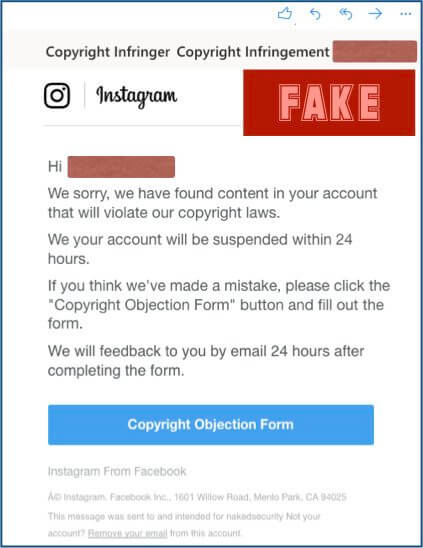
A new phishing scam is targeting most of the Instagram users by accusing them of Copyright Infringement and obtaining their credentials. It baits the users into giving away their login details using bogus copyright infringement alerts. The attack begins with a phishing email distributed as a part of this fake campaign that claims a user's account will be suspended in 24 hours for violating Instagram's Copyright Law. It triggers the users with a copyright notice and the users who wish to refute the claim can do so by clicking on the 'Copyright Objection Form' button embedded in the same email.

FAKE ALERTS OF COPYRIGHT INFRINGEMENT

Instagram news

In the present era, nobody wants to get locked out of their accounts on the social media platforms, even if it's for a while. Consequently, the temptation to click on the email or its buttons is very high. The phishing messages appear similar to the official emails on Instagram. However, the emails have numerous grammatical errors, which are a hint to the users that something is amiss. Clicking the button of 'Copyright Objection Form' redirects the user to a fake Instagram page. Moreover, the page's URL doesn't end in '.com' but in '.cf' which adds to the illusion that the domain is an Instagram one on the mobile web browser.
The page seeks to appear legitimate and official by using an SSL certificate, represented by 'HTTPS' in the address bar and green padlocks. If the users click through, they would then be asked to give their email id, date of birth, and Instagram password. After obtaining all the private information of the users, the phishing page redirects them to the official Instagram login page for maintaining the illusion that the copyright objection form was authentic. If the Instagram users fall for this trick, the hackers can take control of their accounts undisturbed.

WHAT CAN THE USERS DO?

It is a matter of fact that yes; some of the Instagram users are bound to fall for such kind of scams. If you have got either your account hacked or credentials stolen but can still access the account, you first need to check whether your correct email id and mobile number are still associated with your account or not. For doing so, click on 'Edit Profile' option and scroll down to view the current mobile number and email id. If the attackers have changed the info, try to enter your details. After this, you should change your password as well, which would automatically log off all devices currently logged into your account, and give you the full control of your account. In case you lose complete access to your account, you can report the incident to Instagram's security and wait for Instagram to confirm your identity with either your mobile number or email id using which you had signed up.
Such scams are yet another reminder for all the users to read the emails carefully and further inspect the URLs of all the links. They should also enable two-factor

Ref- https://www.kashishworld.com/blog/beware-of-instagrams-new-copyright-phishing-scam/

Tuesday, September 24, 2019

Copyright Infringement And Ways Of Avoiding It

Intellectual works such as written stories, poems, recorded songs, artworks, and photographs are just some of the original creations that can obtain Copyright Protection. It implies that the authors, creators, or artists or these original works own the exclusive rights to sell, distribute, derive, or modify their material. Without the owner's expressed permission, it is not legal for anyone to use the copyrighted work. Otherwise, the owner can sue you for violating the Copyright Law, and you may be held liable for Copyright Infringement.


COPYRIGHT INFRINGEMENT

Copyright Infringement is just another term for theft of ideas and piracy. To be specific, it refers to the act of stealing someone's original creations and violating his Intellectual Property (IP). It is indeed an illegal offense, especially when the person who has copied the idea, recoups all the benefits on behalf of the original creator.

EXAMPLES OF COPYRIGHT INFRINGEMENT
  1. A classic example of copyright infringement involves the use of music in your videos. If you haven't obtained the legal consent to use a song or audio as the background music in your creative works, presentations, or movies, you could be held liable for copyright infringement. Nowadays, various video-sharing social media platforms like Facebook and YouTube actively mute songs and music for preventing Copyright Violation.
  2. Quite often, many creators provide the option of downloading their original works for a fee. However, downloading a TV show, music, software, or movie, that is not owned by the creator leads to copyright violation. Such non-authorized websites automatically prompt you to share the same material with others as well, which results in you redistributing the copyrighted material intentionally or unintentionally and without the owner's permission or knowledge.Another typical example of copyright infringement involves using a creator's artwork, photograph, or graphics in your website's posters, banners, or brochures, without seeking their permission. You can't use such material in your marketing campaigns as well until and unless you either buy the photograph or artwork or pay the creator a certain fee. Furthermore, purchasing or paying for someone's artwork doesn't permit you to use the same for merchandising without any explicit consent.
  3. Even if it's a derivative or inspired work, you can't copy it and claim it as your own; it is referred to as 'plagiarism' in the music or publishing industry.
  4. Although it is reasonably acceptable to record a TV show at home for watching it later; however, passing the recorded material to others, producing a bunch of its copies to sell and gain profit, or broadcasting and posting the video online becomes a case of copyright infringement.

HOW TO AVOID COPYRIGHT INFRINGEMENT

In today's digitally transformed world, it has become ever-easier to reproduce or distribute the original works of the creators. However, the risks and consequences associated with copyright infringement won't be worth the trouble to your finances, peace of mind, reputation, and time. Few tips to avoid copyright infringement are as follows:

Always Assume There's Copyright

Assuming that a created work has copyright protection is the safest option. Even if you don't come across any official statement regarding the public use of that particular material, there's still a probability that someone already owns its Intellectual Property Rights (IPRs). Therefore, it is better to get written consent from the copyright owner whose work you wish to use. Put in efforts to contact the owner for making or negotiating a deal.

Research Well Before Using the IP of Others

Some creators share their works for a price, while others grant permission, only if there is proper attribution. In case there are no attribution conditions or specific fee involved, you must go through the clause of Terms and Conditions on the official website of the copyright owner. Besides, contacting the owner for his expressed consent is usually the best possible way of preventing infringement.

Understand the term 'Fair Use'

Making yourself aware of the rights under 'Fair Use' can help you in taking advantage of the original works for non-commercial endeavors. However, it is imperative to know about a few factors that may affect your usage and its value in the market. Consulting a legal expert on copyright laws can clear your doubts as well.

Pay Someone for the Original Works or Create your Own

If you have the right creative and artistic skills, you can also come up with your original content, rather than copying someone else's work. On the other hand, if you have adequate financial resources, then you can pay other people to be the creator yourself.

Source Free-to-Use Materials under the Public Domain

Nowadays, there are many sources for free-to-use materials under the Public Domain. You can search for the works with 'Creative Commons' (CC) license (enabling the free distribution of the otherwise copyrighted work), which can be commercially viable.

Ref: Copyright Infringement And Ways Of Avoiding It ✅ https://t.co/gs6jVho96A#trademarkregistration #trademark #patentregistration #industrialdesign #copyright #patent #intellectualProperty#IP #kipg #domainname pic.twitter.com/yNbwPwHYRk

Tuesday, September 10, 2019

Protecting Software Innovations – Copyrights Or Patents?

Computer programs or software refer to the instructions executed by a computer. It takes a lot of time, skill, labor, and hard work to develop computer software, which is in the form of source codes and object codes. In today's highly competitive business environment, software innovations have an enormous market value and hence can be copied and used by unauthorized people. Therefore, it is highly advisable to protect the software either under Copyright Law or Patent Law, which at times can be a tough decision to make.


PROTECTION OF SOFTWARE INNOVATIONS UNDER COPYRIGHTS AND PATENTS

Patents or copyrights are the legal forms of Intellectual Property Rights (IPR), which can protect the owner's software source code, invention, or idea. It often becomes necessary for every software developer or designer to choose between a patent and copyright. For making a choice, the developer has to think about what he is protecting. The question is, whether the developer is protecting the code or the idea and process of the software. Obtaining the registration of patents and copyrights are two very different processes and might also change what the owners want to do with their software.
Under the law, both copyrights and patents protect software from theft and infringement. However, each one protects a different part of the software. For instance, patents protect the idea while copyrights protect the written code. Additionally, copyrights don't protect the idea behind the source or object code. To be specific, copyrights don't protect ideas, processes, procedures, and systems, methods of operation, concepts, discoveries, or principles. Software patents, on the other hand, are utility patents (and not design patents), that protect a process, machine, an article of manufacture, a composition of matter, or improvement on an already existing utility.

ADVANTAGES OF SOFTWARE PATENTS OVER COPYRIGHTS

Patents granted for software inventions prevent unauthorized users from utilizing a specific algorithm or creating new software programs (which perform the patent-protected functions), without any explicit permission. On the other hand, copyrights protect only the expression of the idea, i.e., the source code and not the functionality. Therefore, it won't be wrong to say that patents offer a much broader range of protection.
Some of the significant contrasting features between these two forms of Intellectual Property Protection are listed below:
  1. Patents protect the functional aspect of a software invention, whereas copyrights protect only the idea and concept behind the software.
  2. Copyright Protection extends for the owner's or author's lifetime plus an additional period of 60 years, whereas patents last for 20 years.
  3. Software patents are difficult to get, whereas Copyright Registration takes only a few months.
CONCLUSION
Whether any software program or piece of code involves an inventive aspect or not, it must seek protection under Copyright Law. However, the dilemma to obtain Patent Protection arises when there is an invention in a software product or process. In such circumstances, the owner should explore the option of protecting the software invention with a patent as they offer much broader and stronger protection than copyrights.

Ref: https://www.kashishworld.com/blog/protecting-software-innovations-copyrights-or-patents/

Monday, August 26, 2019

How can Intellectual Property Rights Empower Women?

Despite significant efforts made for gender equality, women are still not treated equivalent to men under the law in many parts of the world. Starting from owning land and coming to obtaining legacy, women face a lot of disadvantages. However, an efficient system of Intellectual Property (IP) Protection can help lighten this discrepancy. Intellectual Property Protection can further protect the other rights of women as well. For instance, the countries with a systematic regime of Copyright Protection will, in general, have the highest-paid female artists and actresses too.


The World Intellectual Property Organization (WIPO; encouraging the protection of IP throughout the world) celebrates April 26 as World IP Day every year to promote knowledge about various IP related matters like trademarks, copyrights, patents, etc., along with the crucial role they play in promoting innovations. This year, the theme of this day was, “Powering change: Women in innovation and creativity” for celebrating women and their role in shaping the future of the world economy.

For economic growth and empowering women, protection of Intellectual Property Rights (IPR) is a valuable aspect. IP Rights not only restore financial incentives for women but also give them exclusive power over their unique creations. According to several reports and surveys conducted, nations with effective IP protection laws have better measures of gender equality. If used proficiently, IP Rights can lead to a significant advancement in the entrepreneurship by inspiring women who come up with innovative ideas and inventions. Therefore, IP systems must recognize and appreciate the creativity resulting from the indigenous and traditional knowledge of women across the globe.

Developing countries with weak IP regimes and high population exacerbate disparate living conditions for women. Moreover, they also tend to have higher levels of female unemployment, lower female education rates, and higher infant mortality rates. However, protecting IP can surely change this as the nation that protects IP Rights is also known for its terrific entrepreneurial environment for women. While developed nations usually have more grounded IP protection laws as compared to the developing nations, still they can make efforts to improve the IP protection for women.  As per the Women's Institute for Policy Research, women have quintupled their portrayal among the patent holders since 1977. But, on the other hand, studies and reports have also suggested that women contribute only to 7.7% of primary inventors who own patents.

According to several indexes maintaining the scorecard of how well the countries across the world protect their IP Rights among women, countries that are highly efficient in managing their IP Rights provide women with equal inheritance rights and access to land and credit. Therefore, it won't be wrong to admit the fact, "Empowering women means giving them equal Intellectual Property Rights." Protecting IP Rights is a win-win for all nations.

Protection of these rights will make sure that economic incentives always exist to invest and innovate. It would also lead to worldwide economic growth and prosperity. Everyone should celebrate the role of women by not only counting their past achievements but also encouraging them for future endeavors, advancement, and growth.

Ref: https://www.kashishworld.com/blog/how-can-intellectual-property-rights-empower-women/

Understanding the Concept of Destination Branding through Trademark Protection

 The hospitality industry of India has undoubtedly become an exceedingly crucial service provider across the nation. Due to the increase in ...