Monday, October 7, 2019

Beware of Instagram's New Copyright Phishing Scam!


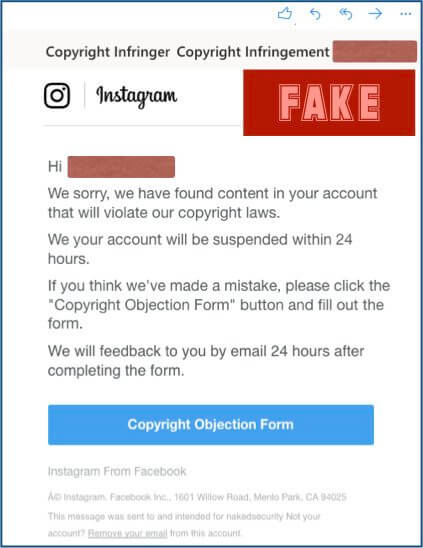
A new phishing scam is targeting most of the Instagram users by accusing them of Copyright Infringement and obtaining their credentials. It baits the users into giving away their login details using bogus copyright infringement alerts. The attack begins with a phishing email distributed as a part of this fake campaign that claims a user's account will be suspended in 24 hours for violating Instagram's Copyright Law. It triggers the users with a copyright notice and the users who wish to refute the claim can do so by clicking on the 'Copyright Objection Form' button embedded in the same email.

FAKE ALERTS OF COPYRIGHT INFRINGEMENT

Instagram news

In the present era, nobody wants to get locked out of their accounts on the social media platforms, even if it's for a while. Consequently, the temptation to click on the email or its buttons is very high. The phishing messages appear similar to the official emails on Instagram. However, the emails have numerous grammatical errors, which are a hint to the users that something is amiss. Clicking the button of 'Copyright Objection Form' redirects the user to a fake Instagram page. Moreover, the page's URL doesn't end in '.com' but in '.cf' which adds to the illusion that the domain is an Instagram one on the mobile web browser.
The page seeks to appear legitimate and official by using an SSL certificate, represented by 'HTTPS' in the address bar and green padlocks. If the users click through, they would then be asked to give their email id, date of birth, and Instagram password. After obtaining all the private information of the users, the phishing page redirects them to the official Instagram login page for maintaining the illusion that the copyright objection form was authentic. If the Instagram users fall for this trick, the hackers can take control of their accounts undisturbed.

WHAT CAN THE USERS DO?

It is a matter of fact that yes; some of the Instagram users are bound to fall for such kind of scams. If you have got either your account hacked or credentials stolen but can still access the account, you first need to check whether your correct email id and mobile number are still associated with your account or not. For doing so, click on 'Edit Profile' option and scroll down to view the current mobile number and email id. If the attackers have changed the info, try to enter your details. After this, you should change your password as well, which would automatically log off all devices currently logged into your account, and give you the full control of your account. In case you lose complete access to your account, you can report the incident to Instagram's security and wait for Instagram to confirm your identity with either your mobile number or email id using which you had signed up.
Such scams are yet another reminder for all the users to read the emails carefully and further inspect the URLs of all the links. They should also enable two-factor

Ref- https://www.kashishworld.com/blog/beware-of-instagrams-new-copyright-phishing-scam/

Friday, October 4, 2019

How to Protect your Intellectual Property (IP) in Foreign Markets

In human history, the greatest of all inventions, social and political advancements, and maximum profit-generating endeavors have undoubtedly originated in the minds of people. They all begin at the same place, i.e., as an intangible idea. Intellectual Property (IP) is a valuable resource and asset in all aspects. From trademarks, copyrights, and trade secrets to patents, industrial designs, and geographical indications, IP is a significant distinguishing factor and a prime driver of revenue for an organization or business firm.


As a general term, IP refers to the set of intangible assets owned and legally protected by an individual or company. The IP holders can prevent unauthorized use or implementation of their unique creations. Furthermore, they can also sell or license their IP to others. In our day to day lives, IP is traded between nations, industries, and people, which further helps in the growth of the global economy. Therefore, every effort must be put in to protect the Intellectual Property Rights (IPRs) of the owners while advancing their shared accessibility simultaneously.

PROTECTING YOUR INTELLECTUAL PROPERTY OVERSEAS

For the ventures that include significant risk, like protecting the IP in foreign markets, the organizations need to craft effective strategies to reduce or transfer such risks. Below are some ways of doing business overseas and protecting your IP.

1- REGISTER TRADEMARKS/COPYRIGHTS AND APPLY FOR PATENTS

Organizations and business firms must register their relevant trademarks or copyrights and apply for patents in their target markets. However, they must familiarize themselves with the fact that every market will have different Intellectual Property Laws and procedures. For more information on the same, organizations can hire a patent or trademark attorney or get in touch with the IP Office of that particular region or market.

2- ESTABLISH CONTRACTUAL SECURITY

Organizations and companies can seek to protect their IP by using legal contracts constructed carefully. The legal contracts for Intellectual Property Protection include the following features:
  1. Non-Disclosure Agreements 
  2. Licenses
  3. Sales Contracts
  4. Employment Agreements
  5. Technology Transfer Agreements
  6. IP Ownership Clauses 
After forming such contracts, the organizations should engage with their business partners regularly to emphasize the crucial importance of the specified clauses and ensure that they understand what those obligations mean for both the parties.

3- IMPLEMENT SECURITY MEASURES

While getting involved in a new international venture, organizations need to boost and strengthen their security procedures, which can help to identify malicious and unauthorized activities by internal and external parties. The organizations can do so by:
  1. Performing background checks on their partners
  2. Restricting the access to IP to only essential contractors, parties, and supply chain partners
  3. Encrypting all forms of IP transmitted electronically or digitally
  4. Prohibiting unauthorized copies of IP on shared network drives or USB devices
  5. Physically locking the areas of IP storage
  6. ACQUIRE INSURANCE
For transferring some of their IP risks, the organizations may consider acquiring insurance. Insurance of IP protects against the enormous legal costs that an organization needs to pay if it pursues its IP claim through the court system. It can include the enforcing claims, i.e., against the infringers who violate the organization's IP and defending claims, i.e., against the organization by another individual or organization.

Thursday, October 3, 2019

Activists Urge Narendra Modi to Protect Drug Patent Rules

In India, the patients' rights advocates have recently asked Prime Minister Narendra Modi to decline any US proposal put forward to dilute the country's Patent Protection and price control regulations. The advocates argued by saying that such proposals may pose a serious threat to India's ability to provide affordable medical treatments, devices, and medicines to its people. Ahead of Modi's planned visit to the United States, he received a letter on September 20, 2019, from these public health groups, which also asked him to protect the Indian government's right to impose price caps on medical equipment and medicines. The letter shows the concern among the patients' rights advocates and public health groups regarding India's discussions of a possible trade agreement with the US, which may lead to changes to India's price control mechanisms and drug control regulations on medical devices and drugs.


The Patent Law in India allows the manufacturers to produce quite inexpensive generic versions of several drugs, ranging from anti-viral medications for HIV infections to anti-cancer medicines. The letter has further highlighted that India’s health ministry, state governments, and millions of its people are highly dependable on the affordable generic medicines, vaccines, and devices, which are domestically produced, and prevent and cure both communicable and non-communicable diseases. The signatories to the letter include the Cancer Patients’ Aid Association, the All India Drug Action Network, the Jan Swasthya Abhiyan (People’s Health Movement), and various other non-government organizations in the health sector. In 2017, the Modi government had imposed price caps on hip implants and coronary stents, which angered many sections of this industry that were demanding differential prices as per the characteristics and features of the medical devices.

The health groups also stated that various sections of the US industry are urging India to replace such price caps with rules and regulations that curb trade margins. The All India Drug Action Network said that the attempt to protect trade margin rationalization is a backdoor attempt to neutralize the price caps, which shall prove to be the most effective way of making critical medical devices and treatments accessible to the patients in the country.

In response to a US move to withdraw quite a few trade benefits to Indian exporters earlier this year, the Indian government had safeguarded its right to protect the public interest. The government stated that India would always uphold its national interests, like the US and other nations, and they aspire for better standards of living by keeping in mind the development imperatives and concerns of people. The public health groups have urged Narendra Modi to uphold this stand on a serious note.

Tuesday, October 1, 2019

Fashion Industry and Intellectual Property Infringement

In today's fast-paced society, the fashion industry is continually evolving. While being a part of almost everyone's daily life, fashion is something to which each one of us can relate. Be it in the form of shoes, or the apparel which we wear, the fashion industry is indeed the most widely-recognized and profit-making industry in the world and yet is also the most vulnerable. Although getting inspired by something or someone is accepted in the modern world; however, at times, this inspiration comes as more of direct imitation than an innovative extension of the original idea. It is a matter of fact that yes; Intellectual Property (IP) Laws act as watchdogs for the creative ideas; quite often it becomes arduous to keep an eye on every development or creation that takes place across the globe every minute.

Intellectual Property Infringement issues not only result when small-time retail shops breach the Intellectual Property Rights (IPRs) of big brands; but even the vice-versa for the same holds to quite an extent. Furthermore, the vulnerability of this industry emerges from the lack of Intellectual Property Protection given to the fashion labels and brands as well. As the innovative ideas and creative fields of the fashion industry stand on the pillars of sincere efforts and flawless skills of the creators, they often sue others for the infringement of their designs.


WHAT CAN BE DONE?

Although Trademark Protection can protect a fashion brand and its entity, it often becomes ineffective against copycat or lookalike products. As the biggest threat to the fashion industry, these copycat products come to the consumer market very quickly after the launch of a new clothing line. Why trademark protection lags in such cases is because the lookalike products don't use the name of the original brand names. Therefore, the protection of IP in the fashion industry requires an agile approach with a strategy flexible enough to keep in pace with the ever-evolving nature of fashion trends. Besides, the fashion designers and creators must tailor the IP strategy to fit their particular niche within the fashion business.

In the creative fashion industry, Copyright Protection can extend to the designs (including fabric prints, lace patterns, and jacquard weave) and products, which are regularly changing and fast-moving. When a lookalike product copies the entire look of the original brand, without using its name, and it doesn't seem feasible to seek or claim Industrial Design Protection, copyrights offer an additional avenue of claim, only when the original fashion design is a work of artistic craftsmanship. In many jurisdictions, protection for copyrights may be broader because of the absence of any specific categories of copyrighted works. However, it is still necessary to show that the works are distinctive and original as what constitutes the term 'original' varies from one jurisdiction to another.

Nowadays, well-established regimes in various jurisdictions grant exclusive powers to the Customs authorities to seize and destroy trademark infringing and counterfeit products. Generally, Customs authorities are more accustomed to identifying trademark-infringing products than those that may infringe copyrights. Therefore, more intensive customs training and detailed product information can help them to spot similarities among designs.

Industrial design protection usually provides a quicker and cheaper way of obtaining a registered IP and protects the features that are prominent in fashion labels and brands, including decoration and design. As an additional route for enforcement, industrial designs protect the appearance of the entire product or a part of it resulting from the features of colors, shapes, textures, contours, lines, or its ornamentation. Industrial Design Registration across the globe has a global novelty requirement, and it isn't cost-effective to seek protection for all novel designs just by predicting the likelihood of their success. The motive must be to protect the novel designs and features of the products that will spark new trends before the infringers begin to violate them.

BOTTOM LINE
For creating new and innovative designs, the fashion industry invests an enormous amount every season. Due to the growing trends of counterfeit items, fashion designers usually fail to protect their IP. Infringers have become more sophisticated in their action than ever before, and subtle lookalike products are present in almost every consumer market. Entirely removing the issue of counterfeiting and copying of designs seems to be next to impossible. However, the creators and brand owners must stay alert and keep themselves aware of the applicable IP laws to safeguard their unique creations and designs.

Monday, September 30, 2019

Apple Sued Over Trademark Abuse In Memoji Registered Trademark

Social Technologies LLC, a digital-based enterprise known for bringing creative social media products to the marketplace, has recently filed a lawsuit at the US District Court for the Southern District of New York by claiming that Apple is fraudulently and improperly using Memoji as a Registered Trademark without even owning the mark in the country. To be specific, the firm claims that Apple has falsely marked Memoji by including it in the Apple Trademark List on its official website and has attempted to defraud the general public to Social Tech's detriment.


Social Technologies has created an Android app called Memoji. In its complaint filed, it has emphasized that Apple is using the encircled R symbol, which denotes a registered trademark corresponding to Memoji on its website instead of using a TM or SM symbol, which denotes a service mark or trademark that the US Patent and Trademark Office (USPTO) hasn't necessarily granted.

The lawsuit filed highlights that Apple was aware of the significant differences within the trademark list page's text, which instructs for either using the listed items only with the appropriate symbol in publications distributed within the US or otherwise including an appropriate trademark attribution notice. Besides, including the Memoji mark in the list has made the case more complicated in connection to a previously filed lawsuit by Social Tech in 2018 over the matter in the Northern District of California.

As per the complaint, Social Technologies had checked the trademark list page on 17th June 2019 and saw Memoji was not there in the list, which was a day before Thomas La Perle, Apple's Senior Director of Trademark and Copyright, had to give a deposition related to the California lawsuit. However, immediately after the deposition, Social Tech claims that Apple updated its list to include the supposed fake designation of Memoji.

The lawsuit further raises the issue of Apple’s extensive advertising of Memoji in promoting iPads and iPhones and using it as a mascot for the entire brand. The complaint has four listings for 'cause of action' including:
  1. False Designation of Trademark as Federally Registered
  2. Dilution of the Memoji Trademark
  3. Violation of New York General Business Law
  4. Unfair Competition
As of now, Social Technologies LLC is seeking monetary damages, attorney's fees, pre- and post-judgment interest, costs and expenses, an injunction to prohibit Apple and its agents from using the registration symbol in connection with Memoji, and the declaration that Social Tech is the only Trademark Holder of the federally registered Memoji trademark.

Ref- https://www.kashishworld.com/blog/apple-sued-over-trademark-abuse-in-memoji-registered-trademark/

Friday, September 27, 2019

Overview And Importance of GST In India

Goods and Services Tax (GST) refers to the tax levied or imposed when a consumer buys a good or avails a service. Proposed as a comprehensive indirect tax by the central and state governments on the manufacture, sales, and consumption of both the goods and services, GST eliminates the cascading effect of taxes on not only the production but also the distribution prices of the goods and services.


THE NEED FOR GST

To explain the impact of cascading taxes, let us consider an example. Suppose A sells goods to B after charging the sales tax and then B, in turn, sells those goods to C after charging the sales tax. In this scenario, while B was computing its sales tax liability, it must have also included the sales tax paid on the previous purchase, and that is how it becomes the case of 'tax on tax' also referred to as 'taxes on taxes' which arises the need for GST to do away with the phenomenon.

CHALLENGES IN THE IMPLEMENTATION OF GST

As India has adopted a dual GST, namely State GST (SGST) and Central GST (CGST), the main hurdle in its implementation is the coordination among different states. The central and state governments have to come to a consensus on the interstate transaction of goods and services, uniform GST rates, and infrastructural requirements to implement the new tax reform; all of which are mandatory for the seamless transition into the GST pattern.

ADVANTAGES OF GST

The introduction of GST in India is a significant step towards the reform of indirect taxation. Combining several state and central taxes into a single tax has overcome the issue of double taxation and led to the establishment of a common national market. From the consumers' point of view, the advantage is in terms of a reduction in the overall tax burden on the goods and services. Successful implementation of GST also helps in giving a strong signal to foreign investors about India's unmatchable ability to support businesses in different fields. With more transparency and efficient compliance, GST has boosted India's GDP and further helped in cheaper and faster movement of goods within the country with a uniform taxation structure. Furthermore, GST has also led to a reduction in prices as manufacturers and traders now don't need to include taxes as a part of their cost of production. Besides, keeping a record of CGST, SGST, and IGST separately is not necessary. The entire process of GST, starting from GST Registration, GST Invoicing, to filing GST Returns, can be done online, which has proved to be extremely beneficial for business firms and organizations, especially startups. Under GST, there are provisions for online payments and compliances and for availing the input credit only when the supplier has accepted the amount, leading to more accountability and regulation in various industries of India, including construction and textile.

BOTTOM LINE

By removing the shortcomings of the supply chain owing to the multi-layered policies, GST has established a transparent and corruption-free tax administration. It is not only investor-friendly or business-friendly but also consumer-friendly to a great extent. Therefore, business owners, entrepreneurs, manufacturers, traders, and citizens must understand that GST is without any doubt the need of the hour and make a point of the fact that any hindrance to its enactment or compliance is unjustified and not in the national interest.

Ref- https://www.kashishworld.com/blog/overview-and-importance-of-gst-in-india/

Thursday, September 26, 2019

Liverpool FC's Request to Trademark 'Liverpool' Denied

The British government's Intellectual Property Office (IPO) has recently rejected Liverpool Football Club's controversial bid to trademark the word 'Liverpool' due to the geographical significance of the city. The club's Trademark Application for the word 'Liverpool' came to light around two months ago with its team and faculty members insisting that their attempt to register the mark was purely in the context of football services and products, and to stop the people who benefit from the sales of inauthentic products.


In spite of the club's repeated insistence that all the revenue generated from the protected services and products would go into the reinvestment, like on transfers and the stadium - their trademark application sparked outrage within their followers, fans, outside supporters, and observers, including the Liverpool mayor Joe Anderson, who was strictly against this trademark move since the very beginning.

After accepting the decision taken by the IPO, the club stated that they would continue to pursue large-scale operations aggressively that seek to exploit their IP illegally and would also influence the relevant authorities to take legal action against such criminal activities.
The club's chief executive officer, Peter Moore, said that the trademark application was put forward only in good faith with the sole purpose of protecting the best interests of the club along with its supporters. He also thanked all those who had engaged with them throughout the process, including the local football clubs and independent traders. Furthermore, he admitted the fact that they had underestimated the level of opposition they received from the independent traders in the city and Liverpool City Council (LCC). In the end, he said that they had felt obliged to protect the club and had even looked at similar situations where the clubs have trademarked their place names in the context of football.

Joe Anderson, in his tweet, said that Liverpool Football Club is a global brand that plays a significant role in showcasing their city around the world. He also stated that he shares a strong relationship with Peter and his team and the club's importance to the future of their city is without question.

Ref- https://www.kashishworld.com/blog/liverpool-fcs-request-to-trademark-liverpool-denied/

Understanding the Concept of Destination Branding through Trademark Protection

 The hospitality industry of India has undoubtedly become an exceedingly crucial service provider across the nation. Due to the increase in ...